Data warehouses designed to support data analysis and business intelligence often employ schemas called Snowflake Schemas to organize large amounts of information efficiently while remaining flexible when retrieval needs change. But exactly what does the Snowflake Schema entail and compare to other models? Lets delve deep into its structure benefits as well as real world applications so we can determine whether it meets your data needs or not.
Understanding Data Warehouse Schemas
Data warehouse schemas serve as blueprints for organizing information, allowing analysts to quickly access relevant insights. While operational databases tend to focus on transaction processing, warehouses are designed for complex calculations requiring well-organized data across large datasets.
Data warehouses often utilize two common schema types known as Star and Snowflake Schemas for data organization: Star Schema and Snowflake Schemas. Each offers unique benefits and tradeoffs; with Snowflake Schema offering multidimensional approaches.
What Is a Snowflake Schema?
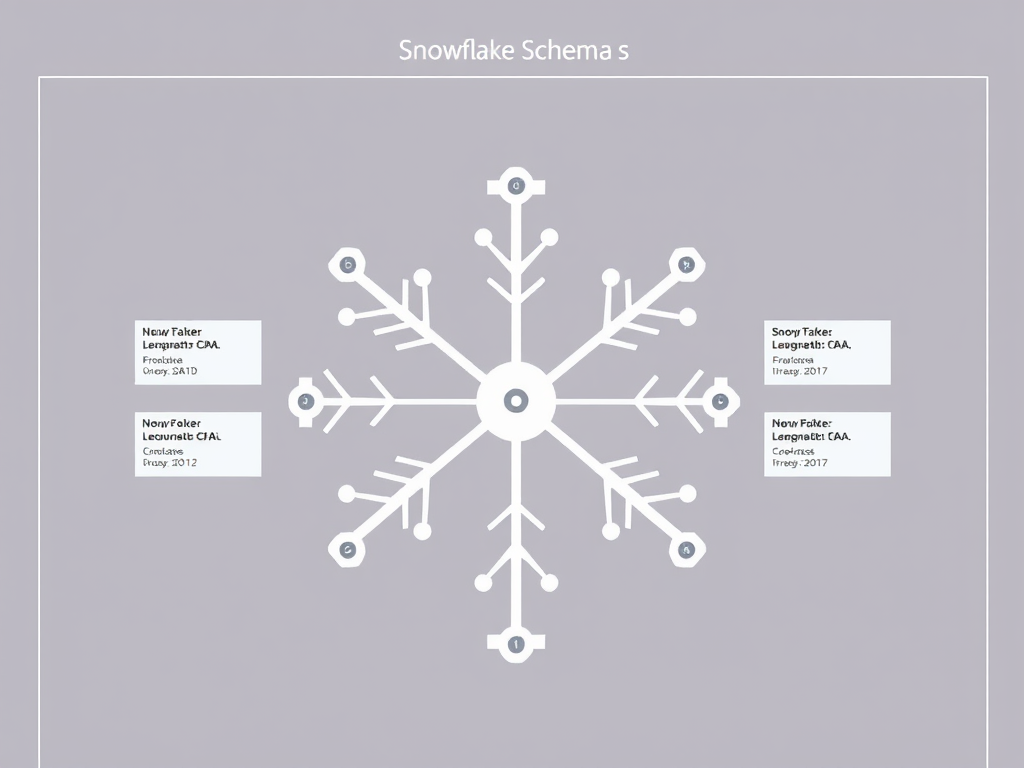
A Snowflake Schema gets its name from its branching structure that resembles that of a snowflake. In contrast to Star Schemas that tend to denormalize dimensions, Snowflake Schema uses a normalized approach by breaking dimensional data down into multiple related tables that break it down more efficiently saving storage space while creating an organized hierarchical data model.
Within a Snowflake Schema:-
- Fact tables connect to multiple dimension tables
- Dimension tables may be divided into smaller tables to represent various levels of hierarchy.
- They also feature multiple layers that correspond with different granularity levels.
Example of Data Organization within Retail Warehouses; “Sales” fact table may relate to “Date” dimension. With Snowflake Schemas, “Date” dimension could be divided up into Year, Month and Day tables allowing better data organization by eliminating duplicated information and duplication.
Key Components of a Snowflake Schema
Snowflake Schemas are composed of various components. Below are its main elements:
- Fact Table:- A fact table serves as the central table that holds quantitative data or metrics such as sales or revenue analysis, connecting various dimension tables using foreign keys that connect them all together.
- Dimension Tables:- These tables hold descriptive attributes about products and customers such as product names or demographic information. A Snowflake Schema normalizes these dimensions into sub-dimensions for further examination of data.
- Sub-Dimensions:- Hierarchical tables representing more granular aspects of main dimensions. For instance, “Product” could be broken down further into its constituent components such as Category, Subcategory and Name.
- Hierarchical Relations:- Snowflake models incorporate schema structures which reflect relationships among dimensions for hierarchical analysis, providing depth and context to data. Each layer adds more nuanced insight.
- Normalization Levels:- Snowflake Schema uses third-normal form (3NF), which minimizes data redundancy while saving storage. At the cost of more complex querying however, Snowflake Schema can bring numerous advantages for users.
Advantages of Using Snowflake Schema
Why do businesses prefer Snowflake Schemas over other schema models? Because of its numerous advantages, such as:-
- Optimized Storage Efficiency:- Snowflake Schema’s focus on normalizing dimensions can significantly decrease data redundancy, leading to significantly reduced costs associated with large databases.
- Increased Data Integrity:- Every data piece appears only once, making updates and maintenance simpler and more reliable while decreasing the risk of inconsistent or duplicate data. This central approach also reduces duplication risk.
- Supports Complex Queries:- With its hierarchical structure, Snowflake Schemas are excellently designed to handle complex analytic queries. Analysts can delve into various hierarchy levels for deep insight.
- Scalability:- Snowflake Schema’s structure is highly adaptable and scalable, easily accommodating additional dimensions or sub-dimensions without major structural adjustments. Challenges and Considerations
Challenges and Considerations
Although Snowflake Schema provides many benefits, its use may not suit every scenario – here are some key challenges associated with its implementation:-
- Complexity in Querying:- Due to its multiple layers of tables, Snowflake Schemas may involve more complex joins that slow down queries compared to simpler schemas.
- Processing Speed:- While normalization reduces storage space needs, Snowflake Schema queries involve additional joins that may impact processing speed when used for high-frequency queries.
- Maintenance Overhead:- As your Snowflake Schema grows in complexity, so too does its maintenance requirements. For instance, adding or altering dimensions may necessitate more thorough planning and updates.
When to Use Snowflake Schema in Your Data Warehouse
Snowflake Schemas are especially useful in data warehouse environments when redundancies exist and storage efficiency is critical. Normalization helps minimize redundancy through Snowflake Schema.
- Hierarchical Data Is Needed:- If your data contains inherent hierarchies (e.g. date breakdowns or geographic hierarchies), Snowflake Schema offers detailed drilling into each level for more granular analysis.
- Complex Analyses Needs:- For businesses relying on advanced reporting or in-depth trend analyses, Snowflake Schemas are ideal. Their multi-layered structure makes this the case.
Conversely, if your organization prioritizes speed for faster data retrieval, a Star Schema might be best as it’s simpler to navigate with fewer joins.
Practical Applications of Snowflake Schema
Snowflake Schemas are commonly employed across industries that deal with complex hierarchical data structures:-
- Retail Analytics:- By employing the Snowflake Schema, retail companies can gain insight into sales patterns across various product categories subcategories and locations allowing for deeper understanding into product performance.
- Financial Reporting:- In finance, segmenting data by various attributes–like account types or transaction dates–makes Snowflake Schemas ideal. They feature hierarchical structures to organize this complex data efficiently.
- Healthcare Data Management:- When managing healthcare data involving complex patient demographics, medical histories and geographical segmentation, Snowflake Schema allows for in-depth accurate reporting.
Conclusion:-
Is Snowflake Schema for You? In snowflake online training , Snowflake Schemas offer organizations seeking detailed hierarchical data views without compromising storage efficiency. When your data warehouse requires complex analysis across multiple levels of granularity, Snowflake Schemas may provide the ideal solution. But be wary when considering its added complexity in light of your team’s analytical needs and infrastructure’s capacity for handling large data sets.
Selecting the optimal schema comes down to understanding a balance between storage efficiency, query complexity and meeting your analysis requirements. When setting up or optimizing an existing data warehouse, Snowflake Schema could provide the framework necessary for structured insightful data organization.
Implementing a Snowflake Schema may offer those looking to take data warehousing to the next level an invaluable advantage in efficiently navigating and analyzing large hierarchical datasets.
 Tech Insights